
ANILA KUMARI
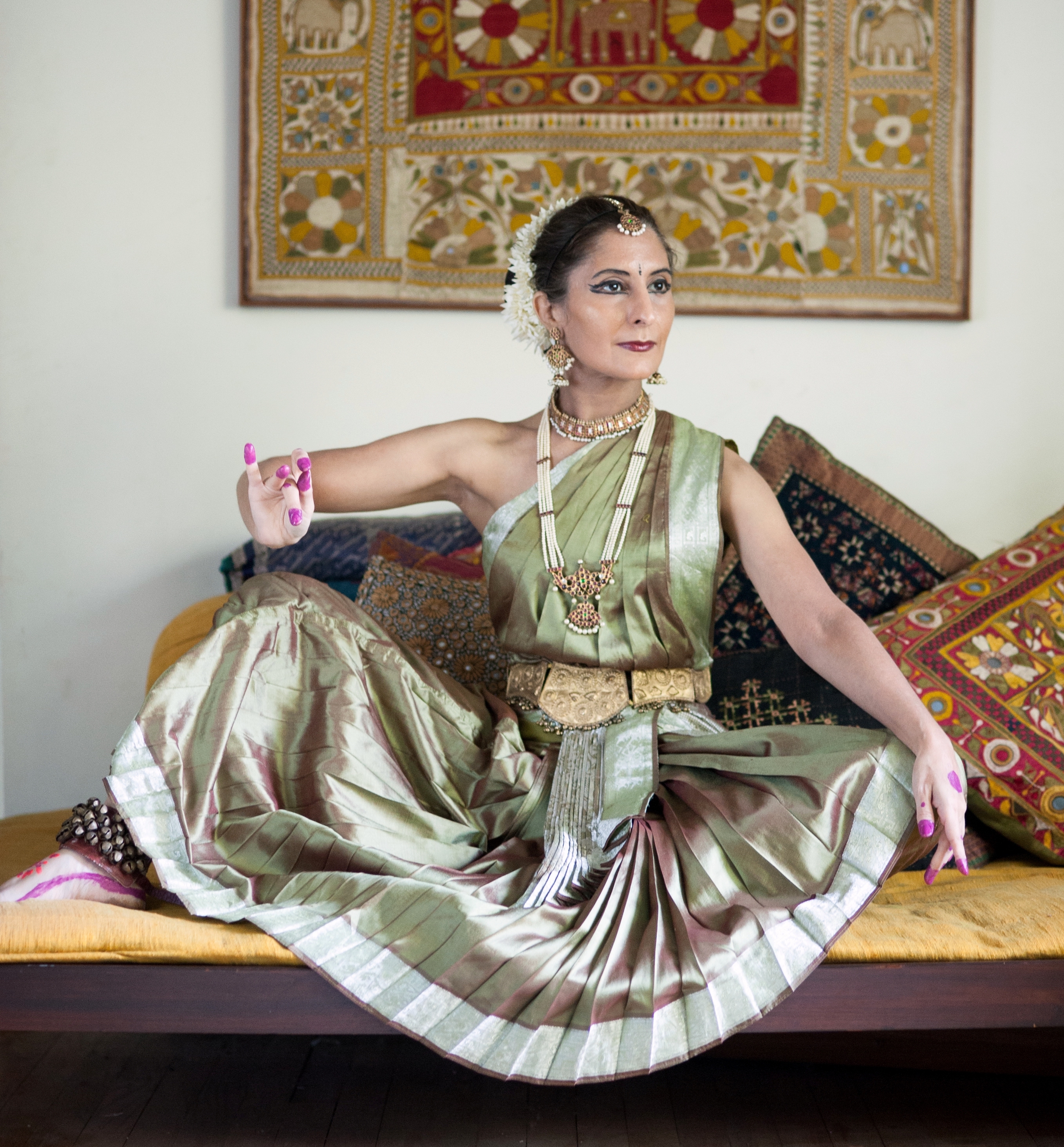
Anila Kumari is an acclaimed dancer, scholar, and educator. Anila Kumari belongs to the artistic lineage and tradition of her mother and teacher, Nilimma Devi – and through her illustrious Kuchipudi gurus – Prahlad Vedantam Sarma, Jaganath Vedantam Sarma and Dr. Nataraja Ramakrishna. Hailed by the Washington Post as “A feast for the eyes. With intricate hand movements, she wove a fantasy fabric of invisible threads across the stage,” Anila has performed on stages in Hyderabad, New Delhi in India, Nairobi Kenya and Iran.
Born in Madison, Wisconsin, in 1969, Kumari began learning dance as soon as she learned to walk. Travelling with her mother Nilimma Devi, she quickly began performing and teaching, adding new choreographic flair and ambition to repertoire they created together, such as ‘Saraswati Vandana’ and ‘Walk the Sky’. She studied Cultural Anthropology at the University of Maryland, publishing a thesis on dance and culture within multiracial immigrant communities, and researched hasta mudra (hand gesture) signifiers and innovation alongside Nilimma Devi on an AIIS fellowship. She has been teaching at Sutradhar since its founding in 1988, and innovated numerous courses such as the Lotus Buds program, Visual Art and Storytelling, Creative Writing, Abhinaya tutorials, and more. An accomplished dramatist and storyteller, she translates Sanskrit poetry into English while preserving its lyricism, allowing Indian Classical Dance to be accessible to a wider English-speaking audience.
She studied abhinaya technique with Priyadarshini Govind and Padmabhushan Kalanidhi Narayanan, and has honed interpretive expression that seeks to empower people and heal internal sense of patriarchal division. Always seeking a way to convey the essence of dance as a language of the soul, she innovated a creative writing class for children struggling with anxiety and other mental health issues, and in 1989 helped develop a mindfulness dance program for inner-city youth through the Davis Dance Studio, D.C..
Anila’s vision unites disparate threads of ancient wisdom from stories that tap into the reservoir of soul as power . She reimagines myths not only to access her own multiple adaptations in a lifetime moving from country to country, but to seek a cross-cultural connectivity in language, visual arts and music that serves today’s generation. Whether it is seeing the underlying unity of a Sufi poem and Satyabhama or teaching second generation immigrants the importance of a living tradition, Anila sees creative work as an interconnected network of progress.
Anila’s choreographic work dwells on metaphors such as cloth and color, praised in the Washington Post: “Long White Robe…the most innovative and accessible… including staccato movements, graceful gestures, direct gazes and prayerful moments.” She has created numerous collaborations between traditional Indian arts and African American gospel traditions, highlighting threads of common ground between different cultures. ‘Why the Trees Dance’, a telling of the Chipko women’s resistance in 1973 Uttar Pradesh, India, paid homage to ecofeminist activism and our relationship as stewards of this planet. In 2020 and 2021, Anila innovated virtual programming to sustain audiences going through the global COVID-19 pandemic with stories of hope. For Diwali in 2021, she wrote and hosted a virtual storytelling in partnership with the Sackler Gallery, Smithsonian, along with a recorded Kuchipudi dance performance by herself and Riya Devi-Ashby. She also organized Pandemic Hues: a virtual gallery for youth and adults to express their feelings around the pandemic in visual art, poetry, and/or dance. In 2017, she was interviewed by the NEA Magazine and shared that “… Kuchipudi dance is not just a tradition, it is a lens through which to celebrate our shared humanity.” In 2021, she also organized a student group Youth Leadership Across an Ocean: to connect kids globally and focus on helping the Shanti Bhavan school combat caste-based poverty.
Her work has been commissioned and presented by the Kennedy Center, Strathmore Arts, Smithsonian Sackler & Freer, National Portrait Gallery, John Hopkins Peabody, National Museum of Women, Lisner of George Washington University, George Mason University, University of Maryland, University of Wisconsin, Towson University, Walters Museum, Silver Spring Civic Center, Dance Place, and supported by such institutions as the Arts and Humanities Council of Montgomery County, Maryland State Arts Council.
AWARDS AND ACCOLADES
National Junior Competition First Place Award, 1986
Individual Artist Award, Maryland State Arts Council, 1994
Master Apprenticeship Award, Maryland State Arts Council, 2012
World Dance Documentary, BBC and Channel 56
“From the Diary of Sita” article in “In Search of Sita” anthology, Penguin Books, 2018
NEA Magazine, Jehan Narialvela, interview and cover story, 2017