
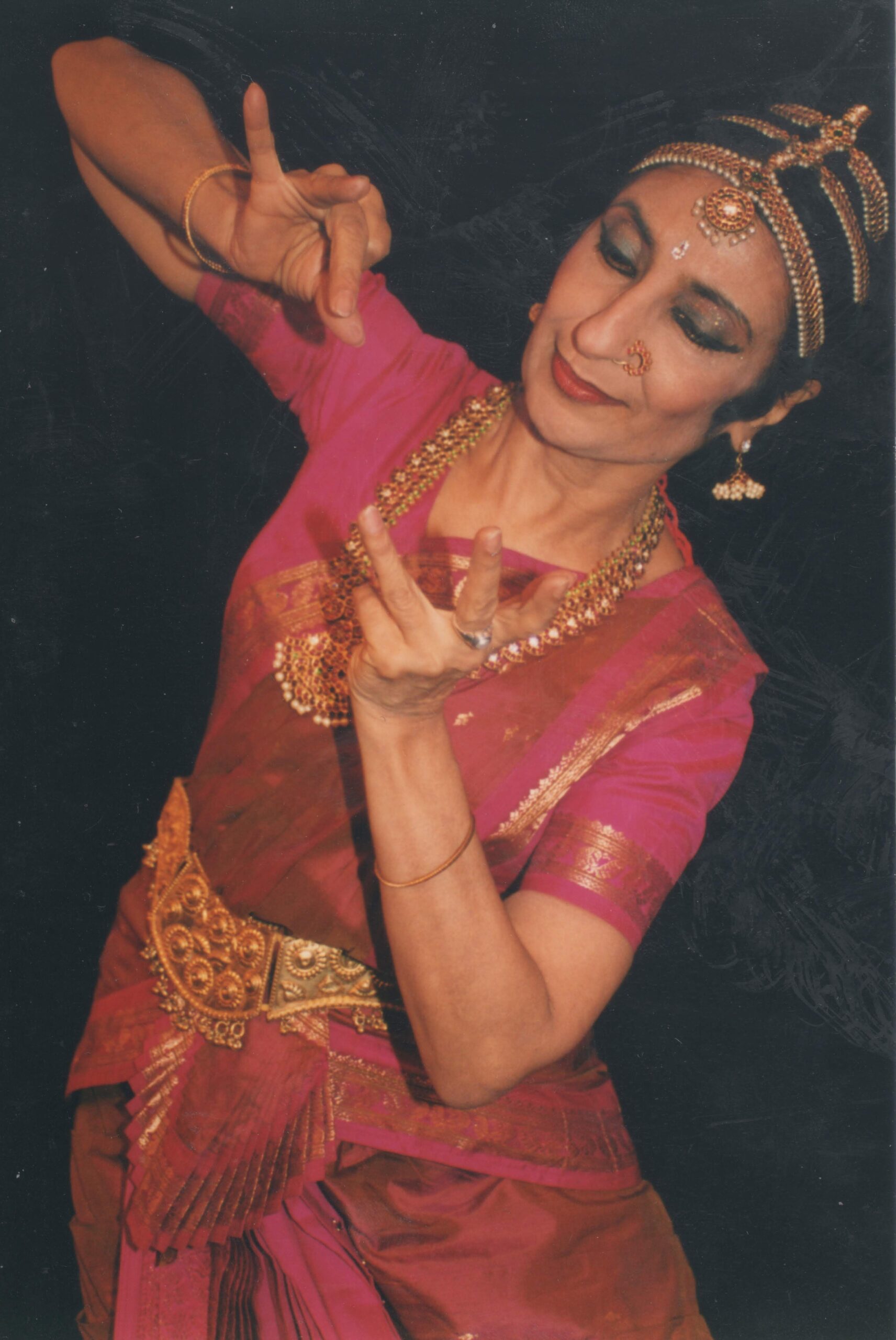
Nilimma Devi is a dancer, scholar, educator, and choreographer whose message of bridging cultures has spanned the globe. In 1988, she founded the Sutradhar Institute of Dance and Related Arts in Maryland, United States where she established Kuchipudi’s rich dance drama curriculum in a haven for collaborative work and social justice. She founded the Sutradhar Dance Company (previously known as the Devi Dance Theater) in 1990 and currently serves as its Founding Artistic Director, Choreographer and Company Manager, together with her daughter Anila Kumari. Nilimma Devi’s work has catalyzed the lyricism of Kuchipudi with contemporary aesthetics in order to bridge worlds.
As a young refugee of Partition-era Punjab, Devi and her family underwent hunger and homelessness in her early years before they resettled in Andhra Pradesh, an experience that has informed her lifelong commitment to intercultural connection and pacifism. When she began to fall in love with dance in Andhra Pradesh, her family didn’t understand her passion, discouraging her from pursuing something so heavily stigmatized during the recent colonial rule. In the 1950s it was unusual for women to learn Kuchipudi, and still more unusual for a non-Telugu speaking person to learn it. Despite these obstacles, when she was 13 she began training with Guru Nataraj Ramakrishna, and has devoted her life to the art ever since. She trained beyond the conventional repertoire, seeking one of the last teaching devadasi from the kingdom of Bobbili, Sanjeevaratna, as well as the most acrobatic movements taught by Dr. Ramakrishna – now all but lost to modern practitioners. As an active teacher she now practices and protects the unique Andhra vani of Prahlad Vedantam Sarma, Jagganath Vedantam Sarma, Dr. Ramakrishna.
When she moved to Madison, Wisconsin with her young family in the 1960s, Devi began to teach and offer lecture demonstrations, introducing countless people to Kuchipudi (and Indian dance) for the very first time. As a young performer, Nilimma Devi saw how language often divided people; eager to broach language barriers for audiences she translated Telugu, Sanskrit and Pali into English. She taught, performed, and mentored people internationally over the next two decades, refining her connection to Kuchipudi and developing her vision for Sutradhar.
She served as an adjunct professor at Shiraz University (1975-77), Goldsmith’s College, and George Washington University. In 1991, she received the Senior Research Fellowship grant from the American Institute of Indian Studies to document gestural code creativity in hand or ‘hasta mudra’ movements in India, research that deeply informed the early days of the Sutradhar Institute.
In 2001 Devi created ‘Walk the Sky’ about the radical poet Mahadevi Akka for the Millennium Stage, a groundbreaking work that remains a cornerstone of Sutradhar’s repertoire. Its combination of feminist voice, poetry, Kuchipudi, and Indian martial arts representing Devi’s newly independent choreographic voice, and she went on to develop many more original dances that embodied her vision. In 2005 Devi was interviewed for Women’s Equality Day by the Voice of America where she emphasized the need for dialogue between not only the men and women, but between the generations, to open the door to transformative thought.
AWARDS AND ACCOLADES
Channel 4 Interview on Culture, Channel 4, 1991
Lecture Demonstration, Association of Asian Studies, 1989
Women’s Equality Day Interview, Voice of America, 2005
CID Member, International Dance Council UNESCO, 2006-Present
CORD Member, International Congress on Research in Dance, 2006-Present
Master Apprenticeship Award, Maryland State Arts Council, 2006
Senior Research Fellow, American Institute of Indian Studies, 1991
Saraswati Award, Indian Minister of Culture for Creativity, 2018
Pola Nirenska Lifetime Achievement Award, Washington Performing Arts Society, 2015
Governor’s Citation, Martin O’Malley, 2007-2010
Councilmember, Maryland State Arts Council, 2007 – 2010